
Heat Pump vs. Gas Furnace in Oregon: Which Costs Less?
Mild damp winters make this a genuine decision for Willamette Valley homeowners. Here is the exact cost, efficiency, and cold-weather performance comparison before you replace your HVAC system.
Executive Summary: Quick Verdict for Oregon Homeowners
- Choose a Heat Pump if: You want year-round heating + air conditioning, live in Western Oregon where winter temps rarely drop below 30°F, and want to take advantage of Energy Trust of Oregon heat pump rebates.
- Choose a Gas Furnace if: Your home already has natural gas lines installed, your primary budget focus is minimal upfront equipment replacement cost, and you already have separate AC.
- Choose Dual Fuel (Hybrid) if: You want the ultra-high efficiency of a heat pump for 90% of Oregon's mild winter days, paired with automatic gas furnace backup during rare freezing arctic blasts.
Heat Pump vs. Gas Furnace in Oregon
How Western Oregon's Climate Shapes Heating Efficiency
Unlike Midwest winters with prolonged sub-zero blizzards, Western Oregon (Silverton, Salem, Portland, and the Willamette Valley) experiences mild, damp winters. Average winter temperatures hover between 38°F and 52°F, with only a handful of freezing nights per season.
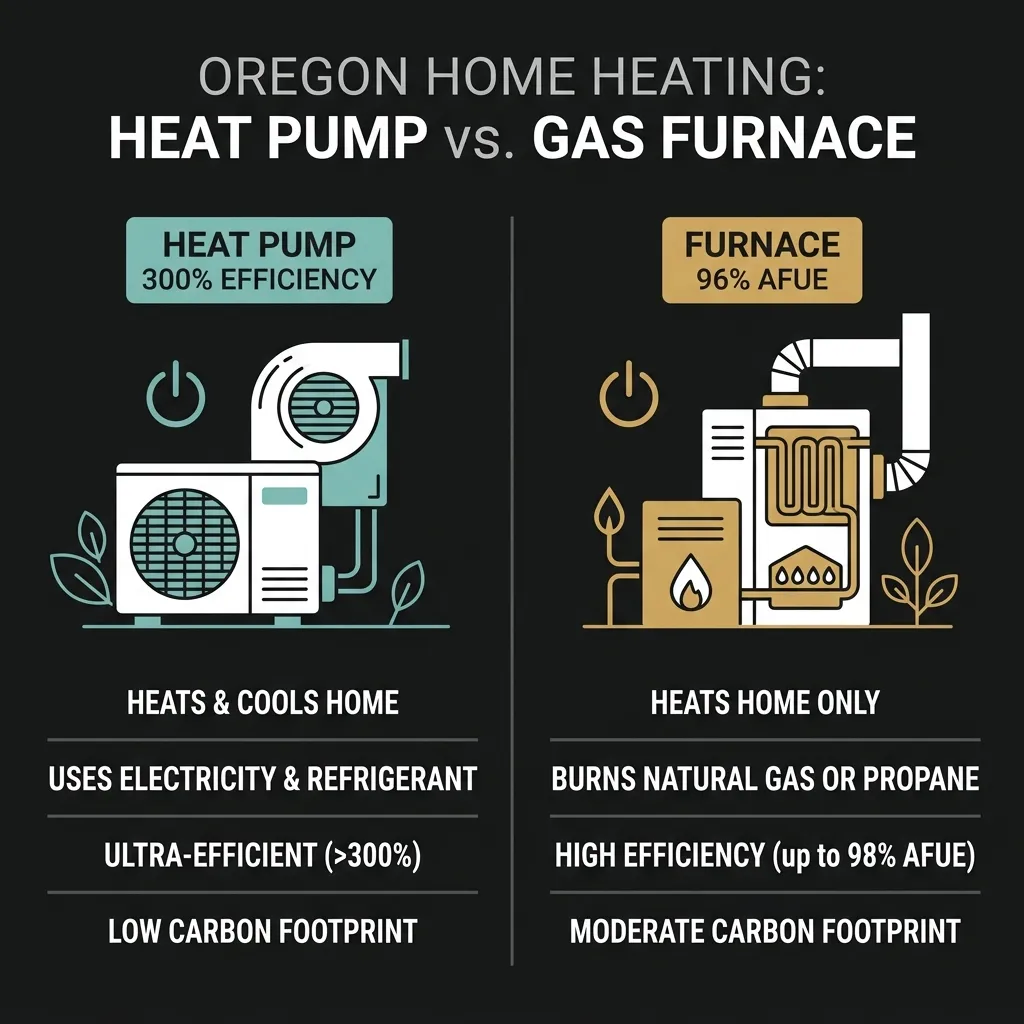
This climate profile makes Oregon the prime target environment for modern inverter heat pumps. Heat pumps do not create heat by burning gas; instead, they extract ambient heat energy from outside air—even cold air—and transfer it into your home.
Heat Pump Advantage in Oregon
Operates at 300% to 400% efficiency in 40°F–50°F Oregon weather. Delivers gentle, continuous warmth and acts as an ultra-quiet central air conditioner all summer.
Gas Furnace Advantage in Oregon
Delivers hot, immediate air output (110°F+) regardless of outdoor temperature. Ideal for older uninsulated homes or homeowners with existing natural gas hookups.
Financial Breakdown: Heat Pump vs. Gas Furnace
When calculating total cost, Oregon homeowners must weigh upfront installation against long-term utility bill savings with Portland General Electric (PGE), Pacific Power, or NW Natural.
| Comparison Metric | High-Efficiency Heat Pump | Standard Gas Furnace | Dual-Fuel Hybrid System |
|---|---|---|---|
| Heating Efficiency (COP / AFUE) | 300% – 400% COP | 80% – 96% AFUE | Maximal (Switches Automatically) |
| Air Conditioning (Summer) | Included (2-in-1 System) | Requires Separate AC Add-on | Included |
| Estimated Annual Heating Bill | $650 – $950 / year | $900 – $1,350 / year | $600 – $880 / year |
| Energy Trust of Oregon Rebates | Up to $2,500+ | $250 – $500 | Up to $2,500+ |
| Expected Equipment Lifespan | 15 – 20 Years | 18 – 25 Years | 18 – 22 Years |
Does a Heat Pump Work in Cold Oregon Weather?
One of the most frequent questions from Silverton and Salem homeowners is: "Will a heat pump keep me warm when temperatures drop below freezing?"
Older 1990s heat pumps struggled when temperatures dipped below 40°F, turning on power-hungry resistive heating coils ("heat strips"). However, today's variable-speed inverter heat pumps (such as Daikin, Bosch, and Lennox systems) are engineered specifically to extract heat energy down to -5°F to 5°F without backup heat strips.
Pro Tip: The Dual-Fuel Compromise
If your house already has natural gas service, a Dual-Fuel System pairs an inverter heat pump with a gas furnace. The heat pump handles mild 40°F+ Oregon days for minimal electric cost, and the gas furnace automatically kicks on only during severe icy spells.
Oregon Heat Pump vs. Furnace FAQs
1. How much can I save in rebates in Oregon?
Energy Trust of Oregon offers cash rebates on qualifying heat pumps ($800–$2,500+, depending on the system and your utility). The federal 25C tax credit ended for systems installed after December 31, 2025, so check Energy Trust and your utility for current incentives. Valley Flow can confirm what you qualify for before you commit.
2. Can I switch from a gas furnace to a heat pump?
Yes! Thousands of Willamette Valley homeowners are converting from gas furnaces or baseboard heaters to electric heat pumps to add central air conditioning while lowering winter utility bills.
3. How long does a heat pump installation take?
Most replacement installations in Silverton and Salem take 1 to 2 business days. Valley Flow handles all permit filings and Energy Trust rebate paperwork for you.
Still Deciding Between Heat Pump vs. Furnace?
Get an exact, no-obligation heat load calculation for your Silverton or Willamette Valley home. Our licensed technicians calculate exact utility payback periods.